
Snake Path, summit fortress and descent
A single desert day: a steep pre-dawn ascent, a couple of hours exploring Herod’s fortress on the plateau, then the descent by trail or cable car.
Segments
- Pre-dawn start at the eastern gate
Eastern visitor centre → Foot of the Snake Path
Desert path
Arrive in the dark at the visitor centre on the Dead Sea shore, fill your water bottles, and walk to the foot of the cliff as the gate opens an hour before sunrise. This is the lowest start of any hike in Israel — the Dead Sea behind you is the lowest point on Earth.
-
 The Snake Path switchbacks
Foot of the Snake Path → Snake Path gate on the plateau
Steep stone steps and switchbacks
Climb the trail that gives Masada's east face its name, winding back and forth up roughly 350 metres of ascent on some 700 steps. Take it steadily and stop to look back as the sky lightens over the Dead Sea. Most people reach the top in 45–60 minutes.
About this place
Geisel Library is the main library building of the University of California, San Diego. It is named in honor of Audrey and Theodor Seuss Geisel, the latter of whom is better known as children's author Dr. Seuss. The building's distinctive architecture, described as occupying "a fascinating nexus between brutalism and futurism", has made it an iconic and widely recognized building on campus. The library is located in the center of the UC San Diego campus.
Read more on Wikipedia ↗Photo: https://www.flickr.com/photos/belisario/ · CC BY-SA 2.0
- Sunrise and the Northern Palace
Snake Path gate → Northern Palace terraces
Plateau paths and stairs
Reach the rim for the sunrise, then walk to Herod's Northern Palace — his private villa built on three terraces cascading down the sheer cliff, with frescoed walls and columns hanging over a 300-metre drop to the desert floor.
-
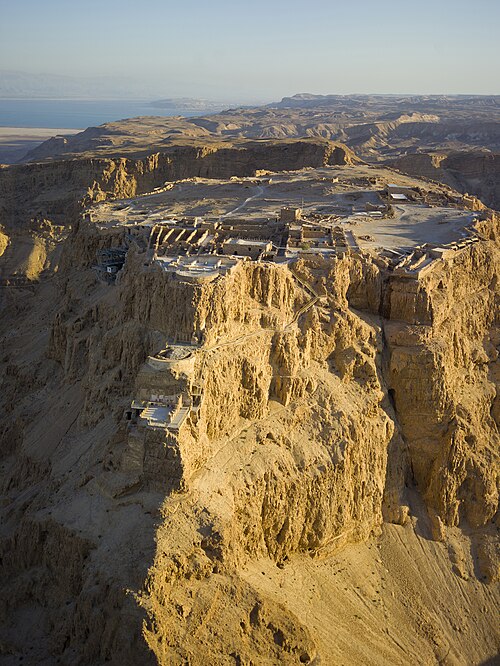 The fortress on top
Northern Palace → Western rampart and siege-ramp viewpoint
Ruined streets and stairs
Cross the plateau past the great cisterns cut into the rock, the bathhouse, the storerooms, and one of the oldest synagogues ever found. From the western wall you look straight down onto the Roman siege ramp and the outlines of the legionary camps that ringed the mountain in 73–74 CE.
About this place
The hilltop fortress of Masada, in present-day Israel, was successfully besieged and taken by Roman imperial forces between 72 and 73 AD, during the final period of the First Jewish–Roman War. At the time, the fortress was held by members of the Sicarii rebel group. The siege is recorded by a single contemporary written source, The Jewish War by Josephus. According to Josephus, the long siege ended with the mass suicide of the Sicarii and resident Jewish families.
Read more on Wikipedia ↗Photo: Godot13 · CC BY-SA 4.0
- Descent to the Dead Sea
Snake Path gate → Eastern visitor centre
Steep switchbacks (or cable car)
Head back down the Snake Path — quicker than the climb at around 35–45 minutes, but hard on the knees and increasingly hot as the morning wears on — or take the cable car down. Rehydrate at the bottom before the heat builds.
About this place
Geisel Library is the main library building of the University of California, San Diego. It is named in honor of Audrey and Theodor Seuss Geisel, the latter of whom is better known as children's author Dr. Seuss. The building's distinctive architecture, described as occupying "a fascinating nexus between brutalism and futurism", has made it an iconic and widely recognized building on campus. The library is located in the center of the UC San Diego campus.
Read more on Wikipedia ↗Photo: https://www.flickr.com/photos/belisario/ · CC BY-SA 2.0