
Westminster to the Tower along the river
A continuous west-to-east line from the Houses of Parliament to the Tower of London, hugging the north bank of the Thames.
Segments
- Big Ben & the Houses of Parliament
Westminster station → Parliament Square
City pavement
Begin beneath the Elizabeth Tower, the 96-metre Gothic clock tower whose great bell, Big Ben, has struck the hour since 1859. Behind it sprawls the Palace of Westminster, seat of Parliament, rebuilt after the fire of 1834. Westminster Abbey, where English monarchs have been crowned since 1066, stands across the square. Allow about 30 minutes to take it in.
-
 Down Whitehall
Parliament Square → Trafalgar Square
City pavement
Walk the broad avenue at the heart of British government, past the gates of Downing Street, the mounted sentries at Horse Guards, and the Cenotaph war memorial in the middle of the road. About 20 minutes on the level.
About this place
Whitehall is a road and area in the City of Westminster, Central London, England. The road forms the first part of the A3212 road from Trafalgar Square to Chelsea. It is the main thoroughfare running south from Trafalgar Square towards Parliament Square. The street is recognised as the centre of the Government of the United Kingdom and is lined with numerous departments and ministries, including the Ministry of Defence, Horse Guards, the Cabinet Office, and much of the Foreign Office. Consequently, the name "Whitehall" is used as a metonym for the British civil service and government, and as the geographic name for the surrounding area.
Read more on Wikipedia ↗Photo: Tbmurray · CC BY 3.0
-
 Trafalgar Square
Whitehall → The National Gallery steps
Paved square
Reach London's grandest public square, laid out to mark Nelson's 1805 victory at Trafalgar. Nelson's Column rises 52 metres above four bronze lions, and the free National Gallery lines the north side. A natural place to pause. About 20 minutes.
About this place
Trafalgar Square is a public square in the City of Westminster in Central London. It was established in the early 19th century around the area known as Charing Cross. Its name commemorates the Battle of Trafalgar, the British naval victory in the Napoleonic Wars over France and Spain that took place on 21 October 1805 off the coast of Cape Trafalgar.
Read more on Wikipedia ↗Photo: Diliff · CC BY-SA 3.0
-
 The Strand & Fleet Street
Trafalgar Square → Ludgate Hill
City pavement
Follow the Strand and then Fleet Street — for centuries the home of British newspapers — east into the City of London, passing the Royal Courts of Justice and Temple. About 30 minutes.
About this place
Fleet Street is a street in London, England. It runs west to east from Temple Bar at the boundary of the cities of London and Westminster to Ludgate Circus at the site of the London Wall and the River Fleet from which the street was named.
Read more on Wikipedia ↗Photo: Josep Renalias · CC BY-SA 3.0
-
 St Paul's Cathedral
Ludgate Hill → St Paul's Churchyard
City pavement
Climb gentle Ludgate Hill to Christopher Wren's masterpiece, completed in 1710 after the Great Fire. Its 111-metre dome dominated the skyline for 250 years; climb the 528 steps for the Whispering Gallery and a view over the City. Around 40 minutes, longer if you go inside.
About this place
St Paul's Cathedral, formally the Cathedral Church of St Paul in London, is an Anglican cathedral in London, England, the seat of the Bishop of London. The cathedral serves as the mother church of the Diocese of London in the Church of England. It is on Ludgate Hill at the highest point of the City of London. Its dedication in honour of Paul the Apostle dates back to the original cathedral church on this site, founded in AD 604. The high-domed present structure, which was completed in 1710, is a Grade I listed building that was designed in the English Baroque style by Sir Christopher Wren. The cathedral's reconstruction was part of a major rebuilding programme initiated in the aftermath of the Great Fire of London. The earlier Gothic cathedral, largely destroyed in the Great Fire, was a central focus for medieval and early modern London, including Paul's walk and St Paul's Churchyard, being the site of St Paul's Cross.
Read more on Wikipedia ↗Photo: Mark Fosh · CC BY 2.0
-
 Along the Thames to the Tower
St Paul's Cathedral → Tower of London
Riverside walkway
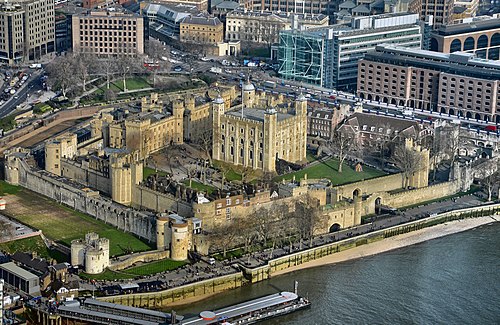
Cross to the river and follow the north bank east, with the Shard and Tower Bridge coming into view, to the Tower of London. Begun by William the Conqueror around 1078, its White Tower has served as fortress, palace, prison and mint, and still guards the Crown Jewels. A fitting end to the walk.
About this place
The Tower of London, officially His Majesty's Royal Palace and Fortress of the Tower of London, is a historic citadel and castle on the north bank of the River Thames in London, England. It lies within the London Borough of Tower Hamlets, which is separated from the eastern edge of the square mile of the City of London by the open space known as Tower Hill. It was founded toward the end of 1066 as part of the Norman Conquest. The White Tower, which gives the castle its name, was built by William the Conqueror in 1078 and was initially a resented symbol of oppression. A grand palace early in its history, it served as a royal residence. The Tower is a complex of several buildings set within two concentric rings of defensive walls and a moat. There were several phases of expansion, mainly under kings Richard I, Henry III, and Edward I in the 12th and 13th centuries.
Read more on Wikipedia ↗Photo: [Duncan] from Nottingham, UK · CC BY 2.0